
FECAL CALPROTECTIN AS A NON-INVASIVE MARKER OF ENDOSCOPIC ACTIVITY IN INFLAMMATORY BOWEL DISEASE: A RETROSPECTIVE STUDY
الكلمات المفتاحية:
Inflammatory bowel disease، Crohn’s disease، Ulcerative colitis، Fecal calprotectin، C-reactive protein، Endoscopy، Biomarkersالملخص
Introduction: Inflammatory bowel disease (IBD) is a chronic, relapsing–remitting inflammatory disorder of the gastrointestinal tract. Its monitoring relies mainly on endoscopy and on clinical scores, which are partly subjective. Fecal and blood biomarkers are increasingly used to reduce the need for endoscopy.
Objective: To assess the correlation of fecal calprotectin (FC), C-reactive protein (CRP), hemoglobin and platelet count with clinical and endoscopic activity, and to compare the diagnostic performance of FC and CRP for detecting endoscopic activity.
Methods: We conducted a retrospective study of IBD patients who underwent FC testing between July 2021 and July 2023 at Mohammed VI University Hospital, Oujda, Morocco. A total of 235 assessments from 155 patients were analyzed. Disease activity was defined using GETAID-recommended scores: Harvey–Bradshaw Index and CDEIS in Crohn’s disease (CD), Mayo score and UCEIS in ulcerative colitis (UC). Correlations were assessed using Spearman’s coefficient (ρ), and diagnostic performance using receiver operating characteristic (ROC) curves.
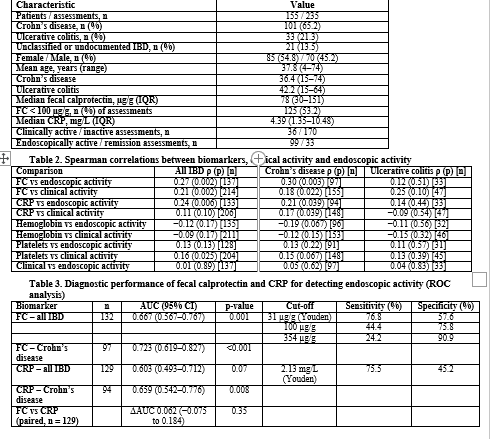
Results and discussion: The cohort included 101 patients with CD, 33 with UC and 21 with unclassified or undocumented IBD; 54.8% were women and the mean age was 37.8 years. Median FC was 78 µg/g and median CRP 4.39 mg/L. FC correlated weakly with endoscopic activity (ρ = 0.27, p = 0.002; ρ = 0.30, p = 0.003 in CD) and with clinical activity (ρ = 0.21, p = 0.002). CRP also correlated weakly with endoscopic activity (ρ = 0.24, p = 0.006) but not with clinical activity (ρ = 0.11, p = 0.10). Clinical and endoscopic activity were not correlated (ρ = 0.01, p = 0.89). The AUC for endoscopic activity was 0.667 (95% CI: 0.567–0.767; p = 0.001) for FC and 0.603 (95% CI: 0.493–0.712; p = 0.07) for CRP; the difference was not significant (p = 0.35). In CD, the AUC of FC was 0.723 (95% CI: 0.619–0.827). At ≥ 354 µg/g, FC had a specificity of 90.9% for endoscopic activity.
Conclusion: FC was the only marker with a significant AUC for endoscopic activity, with a better performance in CD, and high FC values were highly specific for endoscopic inflammation. However, its correlations with disease activity were weak, its advantage over CRP was not significant, and clinical scores did not reflect endoscopic activity. FC is a useful complementary tool to select patients for endoscopy, but it cannot replace endoscopy.
التنزيلات
منشور
إصدار
القسم
الرخصة
الحقوق الفكرية (c) 2026 CC BY-NC-ND 4.0

هذا العمل مرخص بموجب Creative Commons Attribution-NonCommercial-NoDerivatives 4.0 International License.
Moroccan Journal of Biological Sciences (MJBS) is an international, peer-reviewed, open-access scientific journal publishing original research articles, review articles, and short communications in biological, biomedical, environmental, and related life sciences. The journal provides free access to its published articles and charges no article processing fees.