
CLINICAL UTILITY OF FECAL CALPROTECTIN IN INFLAMMATORY BOWEL DISEASE: FROM DIAGNOSIS TO TREATMENT MONITORING
Mots-clés :
Fecal calprotectin, Inflammatory bowel diseases, Crohn’s disease, Ulcerative colitis, Biomarker, Treat-to-target, Assay standardizationRésumé
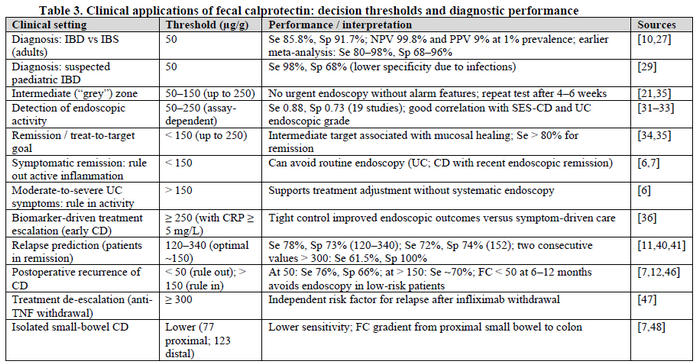
Inflammatory bowel diseases (IBD), mainly Crohn’s disease (CD) and ulcerative colitis (UC), require repeated assessment of mucosal inflammation, for which ileocolonoscopy remains the reference standard despite being invasive and costly. Fecal calprotectin (FC), an S100A8/S100A9 complex released by neutrophils, has become the most widely used non-invasive marker of intestinal inflammation. This narrative review, based on a structured search of PubMed/MEDLINE, Scopus, the Cochrane Library and Google Scholar, critically integrates the analytical and clinical evidence on FC, including guidelines and meta-analyses published between 2023 and 2026. In adults, FC distinguishes IBD from irritable bowel syndrome with a pooled sensitivity of about 86% and specificity of about 92%; its main value lies in its very high negative predictive value at the usual cut-off of 50 µg/g. In established IBD, a value < 150 µg/g (up to 250 µg/g depending on the assay) is used as a treat-to-target goal and to rule out active inflammation in patients in symptomatic remission, whereas values of 150–300 µg/g or rising consecutive values predict relapse with moderate accuracy (sensitivity and specificity of about 72–78%). After ileocolonic resection for CD, a value < 50 µg/g helps to avoid unnecessary endoscopy in low-risk patients. However, FC is not specific to IBD, performs less well in isolated small-bowel CD than in UC or colonic CD, and is strongly influenced by preanalytical conditions, drugs and the lack of inter-assay standardization. Results must therefore be interpreted according to the clinical context, the assay used and serial measurements in the same patient. Future priorities include international standardization, validated home-based tests, context-specific thresholds and combined strategies with intestinal ultrasound.
Téléchargements
Publiée
Numéro
Rubrique
Licence
(c) Copyright CC BY-NC-ND 4.0 2026

Ce travail est disponible sous licence Creative Commons Attribution - Pas d'Utilisation Commerciale - Pas de Modification 4.0 International.
Moroccan Journal of Biological Sciences (MJBS) is an international, peer-reviewed, open-access scientific journal publishing original research articles, review articles, and short communications in biological, biomedical, environmental, and related life sciences. The journal provides free access to its published articles and charges no article processing fees.